Interpreting Ankara's Foreign Policy Shifts (Türkiye)
a Conversation with Dr. Hasan Kösebalaban, PhD

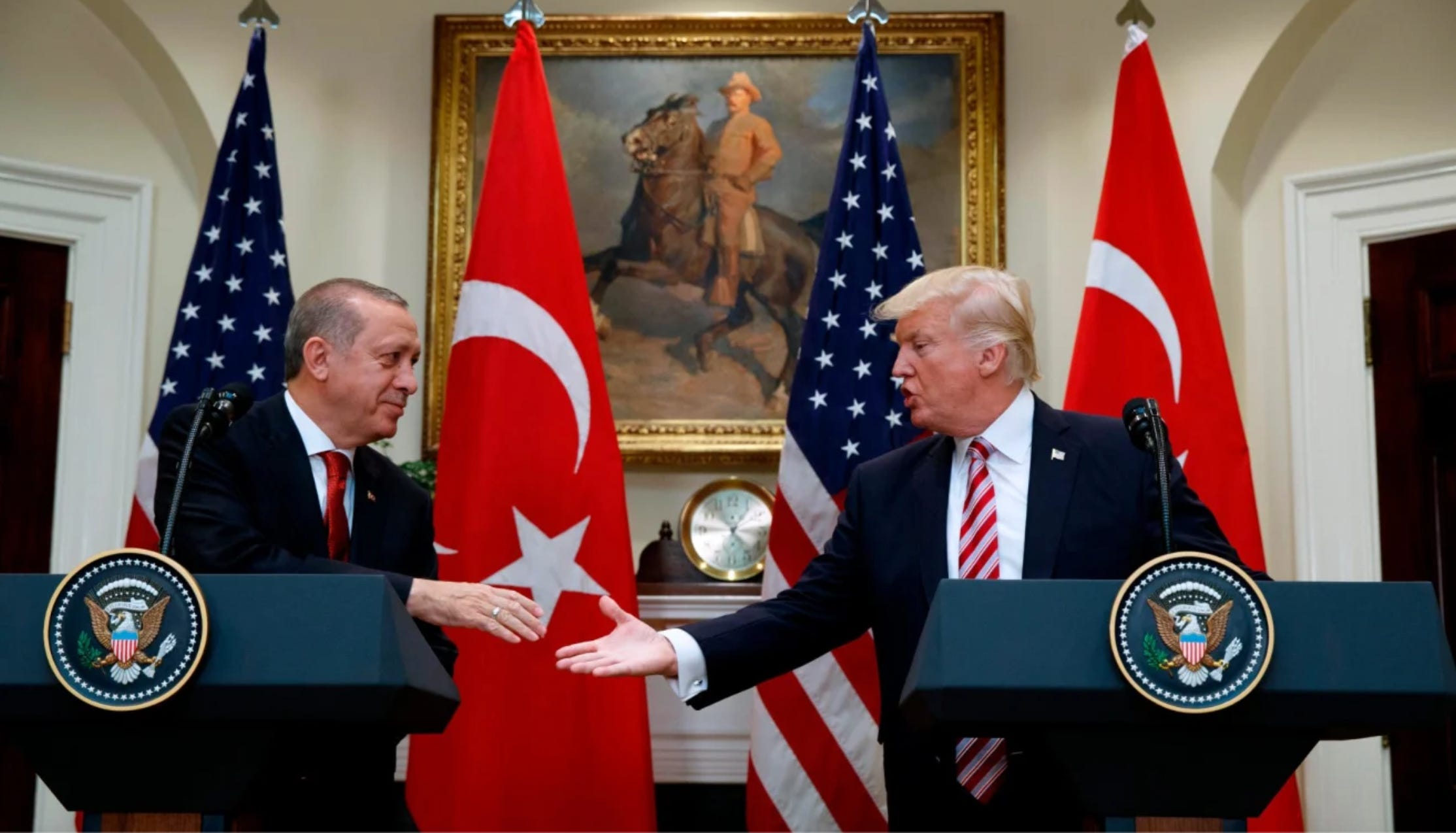
President Donald Trump shakes hands with Turkish President Recep Tayyip Erdogan in the Roosevelt Room of the White House, Tuesday, May 16, 2017. (CREDIT: Evan Vucci/AP)
As the U.S./Israel–Iran conflict (Operation Epic Fury/Roaring Lion) enters its fourth month of protracted back-and-forth attacks, the region manages the repercussions of being within the conflict’s vicinity. The “will they or won’t they” negotiations leave all viewers rolling their eyes as ceasefires feel more like suggestions, declarations from the White House sound more farcical than true, and the pronunciation of Hormuz has become as ubiquitous as the dated “freedom fries” and as popular as “from the river to the sea.”
Although the war may accurately reflect the current state of U.S. foreign policy, some of the questions these events raised are “How exactly has this conflict affected the foreign policy of the various nations within the Middle East?” and “How has the conflict changed domestic policy within individual nations?” For President Erdoğan of Türkiye, the answers can be found in the consistency of his shifting foreign and domestic policies.
A Man for All Seasons
Although Recep Tayyip Erdoğan’s is the president (2014– ) and former prime minister (2003–2014) of The Republic of Türkiye, his equivalent when speaking about foreign policy is Prime Minister Narendra Modi. While Modi is not as volatile as Erdoğan in his comments and decision-making, he is still as wily as anyone when it comes to what he says or does not say to foreign leaders.
To explore this topic, I reached out to Adjunct Professor and Research Associate Hasan Kösebalaban, PhD, of Nazareth University and the author of a recently published book, The Transformation of Turkish Foreign Policy, Edinburgh Press (2026). This book reviews foreign policy under Erdoğan, and looks at how Ankara has shifted its policies while dealing with domestic issues.
Note this interview has been edited for clarity and space.
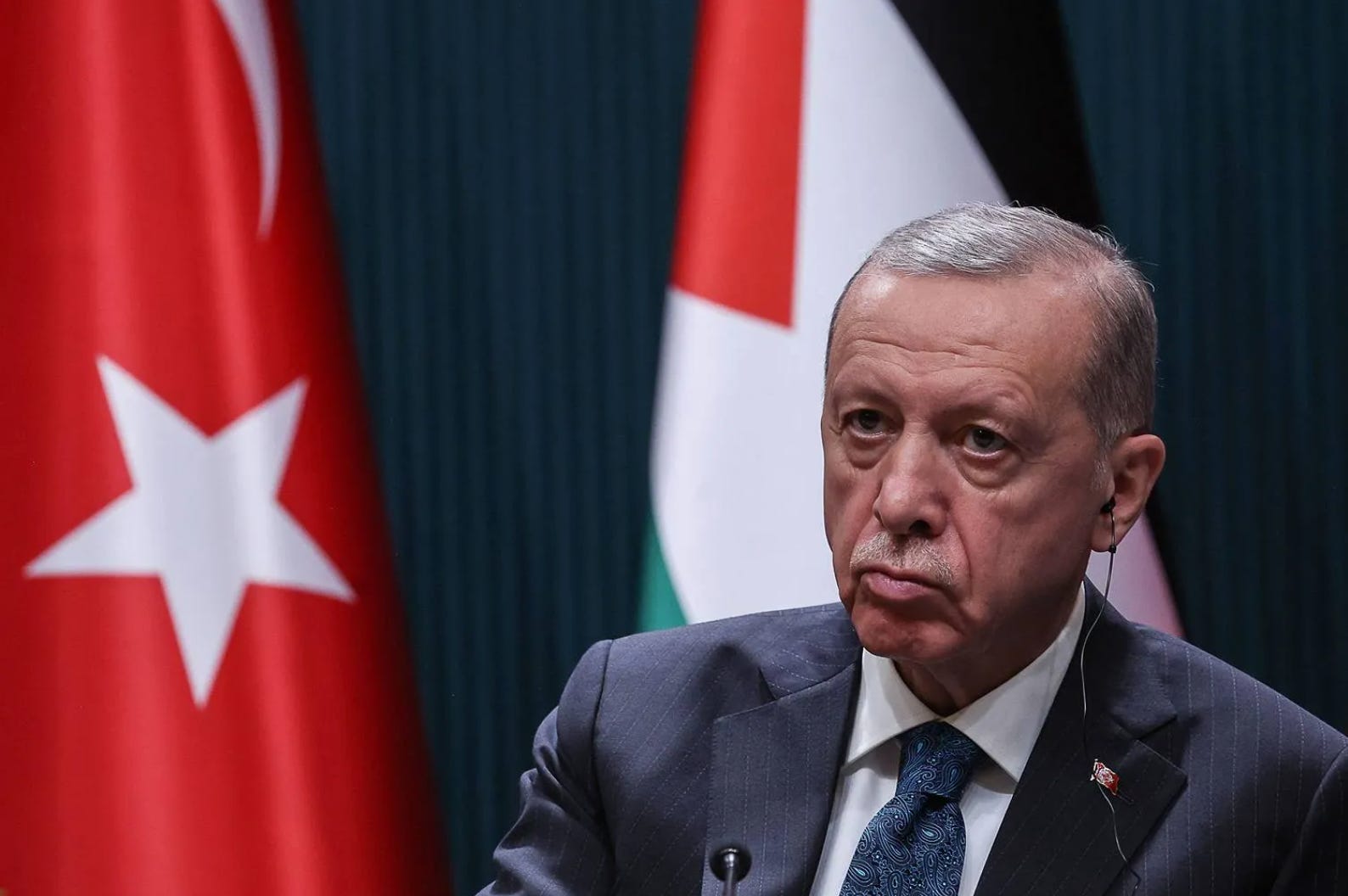
Turkish President Recep Tayyip Erdogan holds a joint press conference with Palestinian President Mahmoud Abbas after their meeting at the presidential complex in Ankara, Turkey, on July 25. (CREDIT Adem Altan/AFP via Getty Images)
Interview
Thibert: I want to start by getting your thoughts on what you realistically think Ankara hopes to gain when the war between the U.S. and Iran ends?
Dr. Kösebalaban: In my interpretation, this is a very unfortunate conflict between the United States and Iran. For its part, Türkiye certainly does not want any destabilization of the region, particularly in the Gulf area, because it is a major financial investment source for Türkiye. So any investments diverted from Türkiye to the Ukraine/Russia war or to the U.S./Iran conflict are certainly not something that Türkiye wishes.
There is nothing for Türkiye to gain in this Iranian war. Türkiye does not want the destabilization of Iran, despite them being a major competitor. Historically, there has always been a competition between the Iranian Empire and whoever occupied the land of today’s Türkiye. This is an ancient conflict, and the Türkiye and Iranian border is one of the oldest in the region dating from the conflict between the Ottoman Empire and Safavid Empire (1623–1639).
Since then, even though Türkiye and Iran don’t like each other, they don’t want any destabilization of either country.
A stable Iran is always good for Türkiye. In the current conflict, there are a lot of losses and only a few gains. Since this is an ongoing conflict, even though it looks like the United States wants to walk away, it cannot. If the conflict mends with the complete destruction of Iran, which the U.S. is capable of doing, this may lead to a hegemonic Israel.
Israel might also look at Türkiye as its next competitor. In this context, Türkiye is not ready for any conflict with Israel. In fact, it doesn’t want any type of conflict with anyone. Instead, Türkiye wants current trade relations with Israel to continue. Despite all these talks that involve both sides, there is a lot of trade between Türkiye and Israel, thus it is in both of their best interests that their current relations continue.
Many tourists from Israel are coming to Türkiye, especially to cities like Antara. Türkiye may actually interpret this as signs that Israel is assuming a more hostile attitude toward Türkiye as it might be their next target.
Thibert: I often hear that Ankara wants to replace Tehran as far as being a regional power. Most recently, the May 2–8 issue of The Economist published an article titled, “This is Not a Drill,” in which this replacement is mentioned. How realistic is this goal?
Dr. Kösebalaban: The Financial Times also wrote a similar article. Türkiye and Iran are two different powers. Oil is a big factor. The fact that Iran controls both the oil and the Hormuz Strait gives it a significant advantage in challenging the status quo of the international system. Where as Türkiye is a systemic power, Iran is an anti-systemic power. This is not a criticism of Iran.
Iran’s best interests are served by being anti-systemic so it can acquire nuclear power systems. Türkiye cannot afford to be an anti-systemic power. It is a resource-poor country that has to maintain strong trade relations with everybody. Türkiye is a trading nation attached to major international institutions. For example, it is an aspiring European Union member. Even though this membership looks very unlikely, nobody has said the process has ended. Officially, it is an aspiring member, a founding Council of Europe member, and a member of NATO. They have no intention to end their membership.
There are talks in Türkiye from all sorts of people who criticize all of these institutions, including the government, but at the same time, it is a pro-Western country. Traditionally speaking, since the Ottoman Empire, Türkiye has always been a major partner of the Western superpowers such as France, Britain, Germany, and now the United States. Türkiye wants to stay that way.
In contrast, Iran is a challenger state. It takes power to be a challenger state, and that power comes from the fact that Iran has significant resources of oil and control of the Straits of Hormuz.
Have I diverted from your question?
Thibert: No, you actually bring me to my next question. How are relations between the U.S. and Türkiye? Have they improved since President Erdoğan’s visit to the White House in September 2025?
Dr. Kösebalaban: The relations have improved very much compared to the first Trump administration. That administration was very rocky in its relationships because of Trump’s rhetoric against Türkiye. At that time, he threatened to destroy Türkiye’s economy. I believe his rhetoric led to a 35% decline in the value of the Lira. That shows how vulnerable the economy is even to verbal attacks.
An American priest, Pastor Andrew Brunson, was arrested in Türkiye in 2017, which is why Trump sent his messages. Qatar was under sanctions. Fethullah Gülen was alive and the main actor in the coup attempt in 2016. The U.S.– Türkiye relationship was very shaky. Now after the return of Trump to power, there is a very strong rapport between the two nations. Personalities seems to be in sync. President Erdoğan is not silent in front of Trump. Unlike in other cases, he is very vocal.
After a night of tumult in Turkey, Erdogan still stands, Aug 11, 2016 (CREDIT CNN)
Thibert: Does the U.S. still need Türkiye? It appears to be fairly reliant on Israel for regional intelligence, and whether that’s factual or not is another issue.
Dr. Kösebalaban: That part of the relationship no longer exists. We are not in the Cold War. I just covered this part at the university. This is not related to Trump. The world is different now. The United States has declined in power compared to the rising power of China. The significance of Europe has declined. according to Türkiye. As for Türkiye, it has increased its power, especially in its military-industrial complex. Türkiye is now a net exporter of weapons It is also decoupling its relationship with the United States, but it is not “de-risking” to borrow a term from finance.
Countries are no longer dependent on any single country in the world. All countries are diversifying their relationships. On one side is the United States, and on the other side is Europe. Then there is Russia and China.
There is also the Middle East. These are all significant relationships. I’m not willing to put myself in America’s shoes to judge the importance of Türkiye, but if I am to speak objectively, not as an observer of Turkish international relations, Iran is certainly of greater importance, but Türkiye’s importance cannot be denied.
Türkiye is in a very volatile region with the Syrian conflict and the Ukrainian conflict. All around Türkiye are conflict zones north and south, and then there is Russia. If I was a political person with a Western perspective, I would definitely not risk losing Türkiye.
To return to the answer of your previous question, the relationships have improved. We see this in the case of Syria. Türkiye is very happy with the change of government in Syria, and the United States supports this change as you can see with the perfume gift that Trump gave Ahmed al-Sharaa. Whatever that means, he could also send a racist message, but I don’t accept that interpretation. I think it was a very nice gesture.
That’s a very good development for Türkiye, but then you have this war with Iran. The United States is completely in harmony with Israel. That is not 100% liked by Türkiye. It does not want to see the U.S. be a copycat of Israel. It wants an independent United States. It wants a strong superpower, but one not willing to fight wars for Israel. In that sense, the war is being criticized, although in a muted sense.
Right now, the Turkish public’s opinion is against the United States. Iran’s sympathy inside of Türkiye is increasing, and that is not liked by the government. Ankara doesn’t want its public’s opinion to be swayed by Iran. President Erdoğan’s charisma, believe it or not, is being eroded by Spanish Prime Minister Pedro Sanchez. He is now a hero in Türkiye. Erdoğan does not poll the same because of economic fragility and other crises inside the country.
Thibert: How has the relationship between Qatar and Türkiye changed since Trump’s re-election and the increase of Israeli operations in the Middle East?
Dr. Kösebalaban: Qatar is a very reliable partner for Türkiye. It is the best partner in the Middle East. Türkiye also has a small military base in Qatar. I don’t have any inside knowledge about it. My own sense is that Qatar has moved to a position of not balancing between Iran and the U.S. They have developed very balanced relationships between themselves and the U.S., Türkiye, and Iran.
Qatar is a political powerhouse. It has been a mediator in many conflicts. Hamas has an office there. The United States’ biggest command center is located in Qatar. Seems that everyone has an office there. While Qatar was enjoying its soft power, Iran made its biggest mistake in counting Qatar on the side of the United States, rather than in its balanced position. By bombing Qatar, Iran forced them to the side of the UAE and Saudi Arabia, which are countries that challenged Qatar’s foreign policy. That is not good for Türkiye. It wants Qatar, which has a balanced foreign policy instead of taking sides. This is the best relationship they can have. Despite of all this, Qatar is still Türkiye’s best ally in the region.
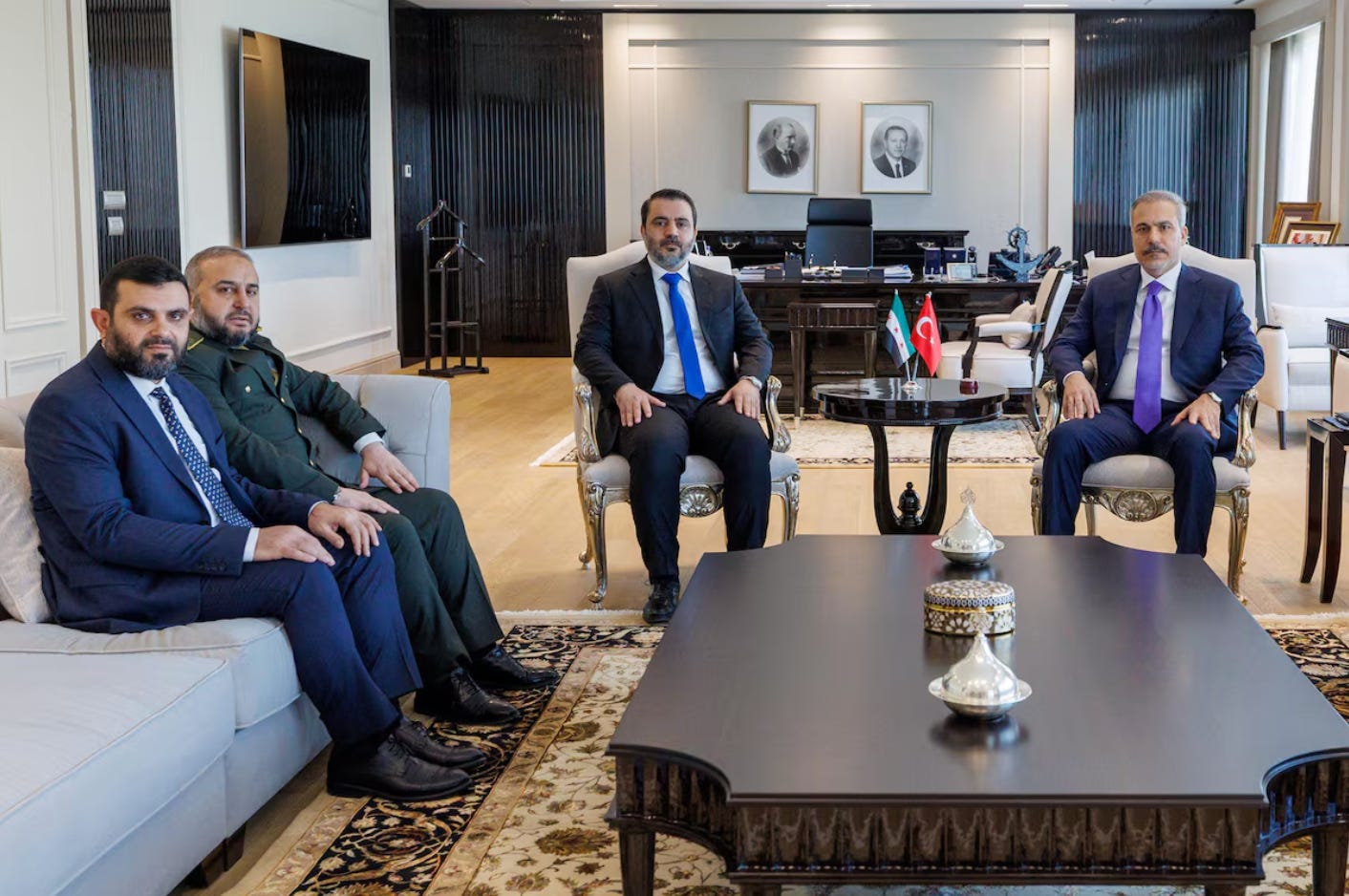
Syrian Foreign Minister Asaad Hassan al-Shibani, accompanied by General Intelligence Service Director Hussein Al-Salama and Defence Minister Murhaf Abu Qasra, meets with his Turkish counterpart Hakan Fidan in Ankara, Turkey, August 13, 2025. (CREDIT: Turkish Foreign Ministry/Handout via REUTERS)
Thibert: Quoting from your book:
“The power vacuum left by Assad’s departure could intensify competition among regional and global actors, including Russia, Iran, and Gulf States each vying for influence. While Türkiye may see an opportunity to curb Kurdish autonomy movements in northern Syria, the instability in the government could also pose security risks, exacerbate border tensions, and increase the likelihood of continued conflict” (pp. 246–247).
Erdoğan and Assad in Syria had a strong relationship. As you mentioned, this has transitioned to President Ahmet al-Sharaa since 2025, especially in regard to their economic ties that has strengthened. How have you viewed their relationship since Bashar’s removal? Do you anticipate any speed bumps along the way?
Dr. Kösebalaban: Erdoğan and Assad had a great relationship before the Arab Spring. Culturally, Assad is a member of a minority sect in Syria (Alawite) that is aligned with their own survival with Iran at the time. In essence, Assad was always closer to Iran than to Türkiye because that’s a fact of the region. There is also a sectarian side of the conflict that Iran capitalizes on. Iran is building a Shia presence through a network of alliances starting from Iran to Ankara to Syria and then Lebanon.
Iran has made a resistance axis based on sectarian solidarity. Even though Assad did not share Iran’s Shi’ism or Twelver Shi’ism, which is the more practiced form of Shi’ism, Syrian Alawites are different. Essentially, Assad was closer to Iran even when he had very good relations with Türkiye. But as I said, the Arab Spring changed that. The Arab Spring was a revolt of the Sunni peoples of Syria, which is the majority of the population, against an Alawite regime.
Iran moved in to support Assad and Türkiye did not. Türkiye sold out and decided to support the Sunni revolt, saying that this is what people actually wanted, that they are a democracy and should support democracy in the region, and then they did the same in Egypt and Tunisia.
The Arab Spring was supported by Türkiye. When Assad dragged his feet in Syria, Türkiye found itself with a tremendous number of refugees, which became a pain. So now this opportunity of a Sunni leader coming back to power in Syria is actually a very good development, strategically speaking.
You now have a leader (Ahmet al-Sharaa) who is of the same interpretation of Islam as Türkiye. Even though he comes from a radical background, it doesn’t mean much in real politics because everyone is very radical in conflicts.
Thibert: So, this is sort of a match made in heaven?
Dr. Kösebalaban: Exactly. Everyone forgot al-Sharaa’s past. Türkiye and the United States didn’t spend a lot of time looking at this background. In conflict times, this type of background is seen as normal. Trump received him in the White House and gave him tremendous legitimacy.
Türkiye likes this development very much, but at the same time, as I mentioned in the book, this is a weak regime and a weak government in Syria. Israel expanded its occupation of Syria, and other power, especially the Kurdish groups affiliated with the PKK, are worried about Türkiye. For its part, Türkiye is worried about its status. If the Kurds gain autonomy, this may all ferment a future rebellion inside Türkiye or the hope for independence in Türkiye, which is their main fear.
There is a new process with the Kurds in Türkiye, and the Kurdistan Workers Party (PKK) leader is a major actor. Türkiye is now rushing to normalize relations with the Kurds and democratize more of them. They are not attracted very much by the negative images in Syria. Everyone is vying for control of Syria, but Syria is a country of its own. Türkiye values a strong Syria. I am not saying this in an idealist sense. From its own interest perspective, it is better for Türkiye if Syria is a strong state. How do you gain this strong state status? Security apparatus. Financial institutions are not very good, so all of these weaknesses are being taken advantage of by other major powers in the region such as Israel, which is not good for Türkiye.
Thibert: Recently, Abullah Öcalan has called for the PKK to lay down their arms. What are your thoughts on this?
Do you believe this will lead to anything?
Dr. Kösebalaban: It may lead to something, and the process is continuous. In my book, I touch upon that issue.
Certainly, there are a lot of good intentions on both sides to continue this process. My criticism is more about the domestic politics of Türkiye. Türkiye is not taking this as a democratization process but as a securitization process.
The entire motivation is more security instead of the interests of democracy. Then use the Kurdish vote for strengthening the authoritarianism inside Türkiye.
Right now, the critical voices in Türkiye fight about this because we have a main opposition party: Cumhuriyet Halk Partisi/Republican People’s Party (CHP). Right now, we are waiting for a court decision about the fate of the CHP.
They may take the CHP and give it to its former president, Kemal Kilicdaroglu, because CHP is the main opposition party. They had a convention, and Kilicdaroglu lost to a younger challenger, Ekrem Imamoglu (Istanbul’s mayor).
Now he is prison and CHP, I mean Erdoğan, might take over CHP. Let me put it this way. The main opposition party in Türkiye might be taken over by Erdoğan soon. Now he needs the support of the Kurds in the Turkish parliament for a constitutional change. It’s better for him to become a candidate in the election. Erdoğan is now serving his third term as president and second term under the presidential system. There is a two-term limit in Türkiye. So he wants to expand that to one more term. For this to happen, he needs the support of the Kurdish parliamentarians.
Note: A decision regarding party head Özgür Özel was made shortly after this interview.
Thibert: You reference this on page 202 of your book about the 2023 re-election and the narrow second-round runoff against Kemal Kilicdaroglu as part of the six-member opposition alliance.
In February 2025, the JDP (AK Party) stated that they are considering moving the next election to November 7, 2027 instead of waiting for May 14, 2028.
Is this related to Erdoğan’s plans to change the constitution? What are your thoughts on this and why the move up?
Dr. Kösebalaban: It could be that the only thing that would allow Erdoğan to be a candidate for the next election is an early election. Just underline this point. The Turkish parliament can force an early election. Right now, Erdoğan supporters in the Parliament are not enough to dissolve it, so he needs Parliamentarians from the Kurdish People’s Equality and Democracy Party (DEM).
The Kurdish process, if it is done, rather than in principal but done just for strategic gains will push the Kurds into a vulnerable position because Türkiye’s Kurds are no longer living in provinces as they now live in large cities, such as Istanbul and Ankara, similar to New York City. NYC and Istanbul have similar cultures. That culture is very difficult for collectivizing votes. Individualism is very strong. Economic crises hit people. So, no matter whether they are Kurds or not, they are human beings, family breadwinners, caretakers of their terrible economy. Then there is opposition that is being crushed. The Kurdish Nationalist Party is saying, “No, we will not buy this.”
Thibert: Do Kurds now feel they are part of the national identity of the country? I remember learning that because of their location in the southeast and surrounding regions, they were not included in the national identity.
Dr. Kösebalaban: They have a strong Kurdish identity, but whether they have a collective identity or not is another thing. You cannot govern Kurdish collective identify from one center. That is my point because Kurds are very much a modern community. That is because they live in urban centers. So, before tribal relations, for example, or sectarian relations, or religious Sufi order, they are all collective identities.
Now individual identities are stronger, but the Kurdish people are very strong in that sense as well. I am not saying they are being assimilated into the larger Türkiye. At the same time, they are also cognitive of the fact that they are one country. In that country, they share economic and democracy crises. It does not matter whether you are Kurd, Black, or White in Türkiye, as you all have the same economic problems.
Syrian immigration, for example, is disliked by both Turks and Kurds. They both see themselves from the same economic perspective. DEM is still a very strong party, but it does not command or control all the Kurds in Türkiye.
They are not getting any democracy-related results from this process, because so far, the DEM people, their leadership, are only talking about the freeing of Abdullah Öcalan from prison. There is another person from the Kurdish Party in prison: Selahattin Demirtas.
HDP candidate Demirtas campaigns against Erdogan from Turkish jail. Jun 14, 2018 (CREDIT DW English)
Thibert: I vaguely remember him from your book.
Dr. Kösebalaban: He has very strong charisma. He is especially liked by the younger members of the Kurdish community. So not everything is about Abdullah. It is a very complex issue. We are not in the 1950s or the 1960s anymore. We are in a different age. It is not even an age of the internet. That’s an old term now. Now its artificial intelligence (AI).
All of these things affect their identity as well. There is greater individualism. Same young problems. Same age problems. My point is the Kurds are still cognizant of their identity as Kurds, but they are part of a larger place in the country that is characterized by economic and democracy crises and wanting to live in a more affluent country.
Thibert: Since the dismissal of Ahmet Davutoglu as foreign minister in 2016, the country has moved on to Mevlut Cavusoglu (2015–2023) and Hakan Fidan (2023– ). How has each subsequent foreign minister tried to define their own terms in this role and have they been able to meet President Erdoğan ’s expectations?
Dr. Kösebalaban: They had much weaker personalities. Davutoglu was certainly an intelligent architect of the new foreign policy after the Cold War. The central power, asymmetric conflicts and so on. He is an intellectual and an academic. So, he was a very strong actor himself. That caused a conflict with Erdoğan. Because Erdoğan wanted a single leadership style, he removed him.
Davutoglu was not removed from the position of foreign minister. He was removed from the position of prime minister. He served as foreign minister, but he was very influential during the time he was office. Then he became prime minister and Erdoğan became president. Then he resigned from that post as prime minister. In both cases, you are not wrong. In both positions as foreign minister and prime minister, Davutoglu was followed by weak leaders and personalities.
Hakan Fidan, today’s Türkiye’s foreign minister, is one of the aspiring names, not as far as political ambition, but one of the names that comes to the minds of people to follow Erdoğan. Erdoğan’s age is now old age. People are starting to talk about succession within his party. Hakan’s name comes up. Erdoğan’s son Bilal Erodogan comes up.
Fidan may be different from Davutoglu in this sense. The foreign policy of the country is firmly controlled by Erdoğan. Every minister is weak in Türkiye today except the position of the president.
In the past, we had some charismatic house ministers. Now we have none, only bureaucrats running ministries and Erdoğan controlling everything.
Thibert: So Erdoğan does not want anyone to outshine him?
Dr. Kösebalaban: Exactly. He doesn’t let anyone use positions to outshine him. They have some charisma-inspiring personalities within the party. He keeps them out of higher offices. Actually, in two cases, he forced them to establish their own parties. One is Ahmet Davutoglu, who established the Gelecek Partisi GP (Future Party). The other is Ali Babacan, who founded the Demokrasi ve Atilim Partisis DEVA (Democracy and Progress Party). He was the minister of the economy, which means he was the single controller of economy.
Now, there are no people like these anymore. They actually sold this consolidation of power within the AKP (JDP) circles in the beginning. They would say that, “You need to consolidate power.” “This separation of power is so Western.” “It delays the process of decision making.” Now they see power is a very dangerous thing. To put all of this power into a single man, whether he is Erdoğan or the opposition, doesn’t matter. A single man is not capable of doing everything. He certainly needs top people in high positions.
I am not saying Turkish ministers are not capable of their positions, but they are not capable or equal in charisma terms as their predecessors.
Turkish Prime Minister Ahmet Davutoglu confirms he will step down at AK Party Congress, May 6, 2016 (CREDIT: Euro News)
Thibert: This reminds me of what happened after the passing of Tito of Yugoslavia. No one was suitable to take his place. Unfortunately, this left erosion that took decades to repair. Is that something that could also happen with him? If Erdoğan passes away suddenly, there appears to be no one to take the reins.
Could Türkiye begin to fall apart?
Dr. Kösebalaban: This took place with Halil Turgut Özal, prime minister (1983–1989) and President (1989–1993) of Türkiye and controlling the Motherland political party. Then he suddenly passed away after becoming president.
The party went to a weaker leader. Similar to Erdoğan’s case when he became president he replaced Davutoglu with a weaker leader.
Fate is fate. Death comes to all of us. I don’t wish for that to happen. At the same time, this is a natural fact. If that happens now at this point, the party would crumble. No question about this. It will crumble. Actually, in the case of Özal, it did the same thing. In the case of Suleyman Demirel actually became president and left the Justice Party. It did not survive.
Usually in Türkiye, right-wing central parties similar to Erdoğan’s and Özal’s parties are not ideological parties. Even though there is a relative ideology in Erdoğan’s party, they are really interesting parties. They are catch-all parties.
They gather people from all around the country and they use them to serve their best interests as either selfish politicians or aspiring people. When the leader dies, then there is no hope for the party. Members just leave the party.
There is no ideology that holds them together. In contrast, we have ideological parties such as a Nationalist Party, the Kurdish National Party, and the Kurdish Nations Party. They survive these crises. What keeps them together is not their interest but their ideological commitment. It is not there in the ruling party.
Thibert: I want to shift gears a bit and ask a few more questions related to your recently published book: The Transformation of Turkish Foreign Policy:
“Since the late 2010s, Turkey has undergone a profound ideological transformation, with nationalism emerging as the dominant political and strategic framework. This shift has had significant implications not only for Turkey’s domestic governance, but also for its foreign policy orientation? (p. vii).
What are Türkiye’s current domestic policies and how have they shaped the current foreign policy?
Dr. Kösebalaban: There is always a strong interaction between domestic and foreign policy realms. Today, Türkiye is experiencing increased authoritarianism. This needs a particular type of foreign policy that does not make Türkiye a part of the EU because, if it moves ahead with membership, it has to give up its authoritarian. EU membership and authoritarianism does not go together.
In relations with the U.S., it is issue by issue kind of relationship. The U.S. doesn’t care whether Türkiye is democratic or not. It never cared in the case of Türkiye. It supported military takeovers in the past. This is very much expressed by the Trump administration and the people in his administration need strong men. Trump has even said that he likes strong men. He didn’t say any words about democracy.
Europeans also like a strong man in Türkiye. This may be a little confusing, but would the EU’s membership care about Türkiye’s progress to join the EU membership or care about the refuges not being sent to them by the authoritarians?
We have to be honest about this. Europeans don’t care about Türkiye’s EU membership process. If Ankara sincerely moved toward a perfect democracy, Europe would also find itself in difficulty. They don’t want to accept Türkiye, which is a fact. They would have an enormous difficulty accepting or rejecting members. Right now, they are happy as long as their interests are served. So, Erdoğan focuses more on the Middle East, which is not democratic so he finds himself at home there.
There is a particular foreign policy of authoritarianism and that’s being experienced right now.
Thibert: My next quote comes from journalist Hannah Smith’s book, A Warning to Europe: Erdoğan Rising,
“Erdoğan is no fool. He knows how important he is and he plays on it, often seeming to push his Western allies’ buttons just to see what will happen. He may sometimes look like a man deranged, but he is also a smart political operator.”
Your thoughts on this statement?
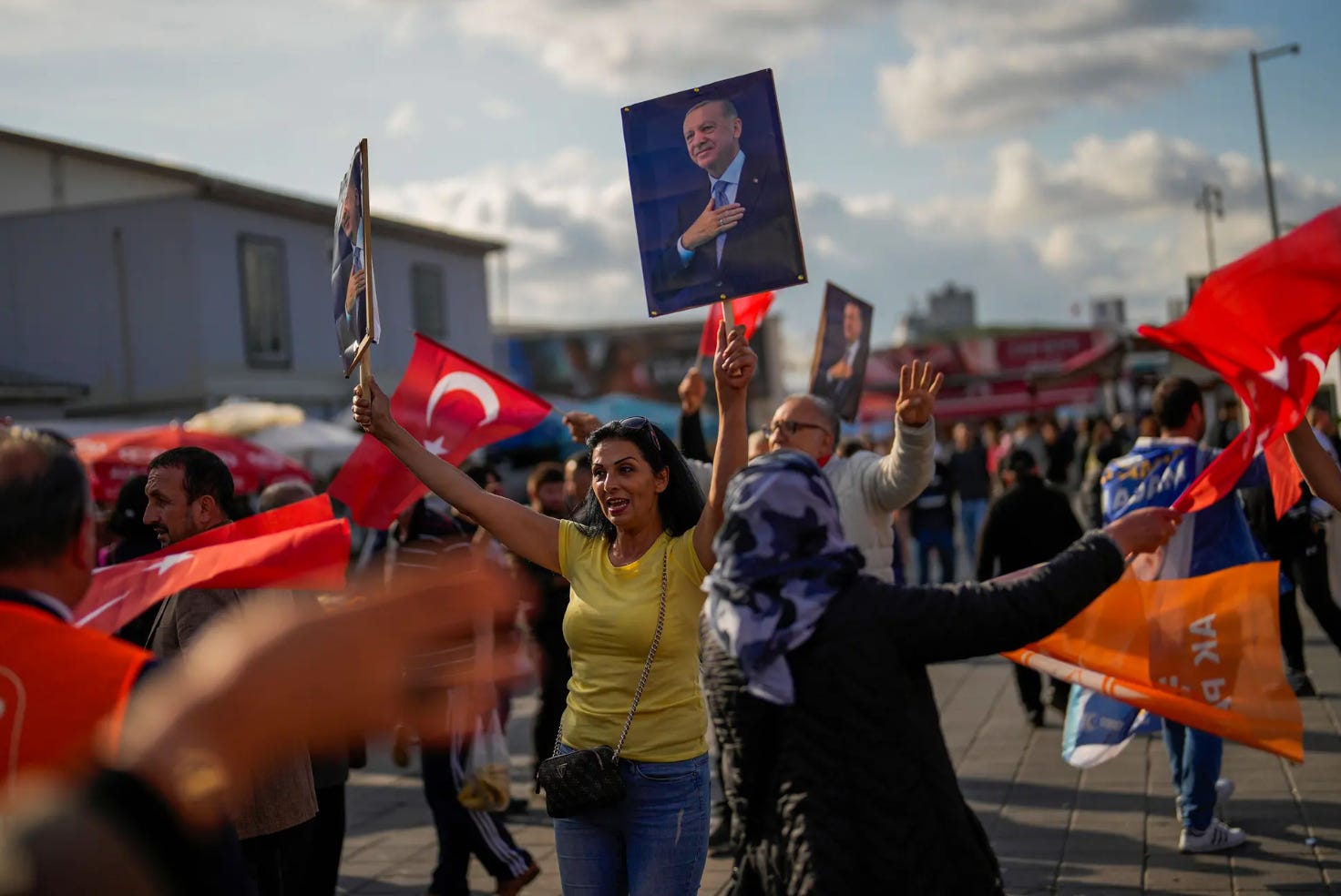
Supporters of Turkish President and People’s Alliance’s presidential candidate Recep Tayyip Erdogan dance as they give handouts to commuters in Istanbul, Turkey, on May 23, 2023. (CREDIT: Francisco Seco—AP)
Dr. Kösebalaban: Erdoğan is a very smart political operator. There is no doubt about this. He is not ideological. He is pragmatic. The best pragmatic politician in Türkiye. He is also very flexible. He may say things today. He may change and say completely different things tomorrow. His base doesn’t leave or judge him according to what he does or says. It is almost a prophetic relationship. It is a strong word if the word is translated a certain way.
Let’s say he has a romantic relationship with his base. The base doesn’t leave Erdoğan. There are challenging parties so he knows his advantages. The base likes him very much. He has a strong charisma that is untarnished by everything he does or doesn’t do. He doesn’t succumb to an ideological based foreign policy. He is a survivor in all crises. I think he is perhaps the best politician in the history of Türkiye.
Thibert: You comment on page 191 that, in the mid-2010s, relations with Saudi Arabia and the UAE deteriorated significantly. The July 15, 2016 attempted coup deepened tensions. The 2018 murder of Jamal Khashoggi further escalated tensions. You also remark on the JDP’s opposition to the Abraham Accords. By the early 2020s, most of these relationships appear to have been mended (2015).
Is that Erdoğan’s gift? Does his mercurial attitude aid in mending relationships?
Dr. Kösebalaban: Exactly. He did a complete U-turn in the relations with the Saudis, the UAE, and Egypt under El-Sisi. Now he embraces all of them as brothers. That is a tremendous ability to sell this as foreign policy successes to his base.
Intellectual people understand this. Some intellectual people don’t talk and some other people talk and they risk a lot. Everyone is aware what is going on. I also give credit to this neutralization. I don’t want to see continued escalation. When he escalated, he did the wrong thing, but he corrected and normalized it. This is a good thing.
His base doesn’t see him as someone who is erratic and makes mistakes. They don’t see him as an unstable sort of character. His base continues firm support of him. Who is his base? About 30%–35% of the population is his fixed support. He can add to this 35% by manipulating other segments of the population. Some people would work for him, for example, just for the sake of stability. Some people vote for him because of the Kurdish progress. Then if he reaches 50%, it is all about the challengers not about him.
Thibert: Is Erdoğan not viewed as a hypocrite? Especially towards his relationship with Israel after Gaza (2023). For example, denouncing Netanyahu but continuing to trade.
Dr. Kösebalaban: There are lots of people who criticize him. My point is that his base doesn’t leave him because of foreign policy. It’s a messianic and very romantic relationship with him. They don’t abandon him. That is a very interesting thing. I can’t explain in rational terms. There is nothing rational about this. There is a complete economic disaster in Türkiye right now. People are digging into the rubbish to find food that other people throw away. This was unseen in the history of Türkiye.
I grew up when there was an economic crisis. Türkiye’s famous public markets were abandoned, compared to the United States, which is suffering from a major food crisis. Right now, everything is very expensive. The same supermarket basket bought in Istanbul from a moderate store was compared to a London market. London is one of the most expensive places in Europe. Then believe it or not they showed the receipt. Türkiye was more expensive.
Yes, the food prices are increasing in the United States. Still people make only $6 or $15 in New York state, but they can still go and buy meat. In Türkiye, buying meat is now a luxury. Buying vegetables was easy, but now is a luxury. Despite all of this, nothing changes for 30%–35% of the people.
Ali Babacan who was the architect of early economic success in the AKP, now has a political party that is not even 1%. This is crazy.
Thibert: This is a bit surprising for me to hear. In the U.S. when the economy is not doing well and costs go up, people are upset. Yet this is not happening here. Is this part of Erdoğan’s cult of personality? A general acceptance? From my perspective, it is a little hard to understand this.
Dr. Kösebalaban: I agree. In the United States, if you judge from the Kentucky primary votes, Trump’s endorsement of one candidate (Republican Congressman Andy Barr) over another was certainly a factor in the decision to vote for Barr, especially among elderly people or people of a certain age.
One thing that explains Erdoğan’s charisma and his unpopularity is the experience in Türkiye with extreme secularism. Before the coming to power of the JDP, Türkiye had a military supported secularist crackdown on religiosity. Head scarfs were banned in universities, for example. Religious schools were closed down. In the entire history of Türkiye, secularism was imposed from top down. Azaan (call to prayer) was banned in minarets for many decades. So all these left lasting grievances in the minds of conservative society. Then the main opposition party is CHP. As the party of secularism, it has this image that the current leaders, especially Istanbul Mayor Ekrem Imamoglu is a different person.
There is this fear in this conservative half of the population that if they don’t support Erdoğan, then CHP will come to power. They may see this secularist crack down again. This may happen; I cannot guarantee. Erdoğan polarized the country and then before him the secularists polarized the country. So Türkiye has this history of very severe polarization. In this context, people like Erdoğan may survive in power.
We have a former Turkish politician who said “The kitchen may topple a government” because, if the kitchen is empty, then the people may revolt, but that logic doesn’t work in the context of ideological polarization.
Thibert: Over the last five to eight years, there has been rising nationalist, anti-immigrant, anti-Islam sentiments in Europe Using this, coupled with Türkiye’s own nationalist pivot, Erdoğan created an environment where Islamism is increasingly framed within the context of state sovereignty rather than transnational political movements. Has Erdoğan made any statements or expressed his opinions on this?
Dr. Kösebalaban: He doesn’t express many sentiments about Islamophobia in Europe. Certainly, he is concerned about Islamophobia increasing in Europe because there is a Turkish population in Europe. About 5.0 million people in Europe have strong attachment to Erdoğan.
They immigrated in the early 1960s or so. If things changed drastically in Europe and their lives become unbearable, then they will come back to Türkiye. That will put another strain on the economy. It’s also not in the interest of Türkiye to lose this population in Europe. They are not rooted because they are a second, third generation in Europe. Erdoğan expressed this.
Turkish citizens in Europe can vote in Turkish elections. People who have no economic connection to Türkiye can vote for the fate of Türkiye’s economy. For them, Erdoğan is actually a very charismatic, nationalist leader with a strong leadership record. This is the only attraction for them to vote for Erdoğan.
The Turkish minority in Europe lives in their own reality. They are Turks, they are muslims, but they don’t live in Türkiye. What I mean is that they don’t experience the fate in the Turkish economy, but then they vote in elections. It’s very peculiar, a strange thing, in my opinion. For them, Erdoğan’s leadership is very important. The majority of them are Erdoğan’s supporters. In Europe, Erdoğan has very solid support. He has to defend their interest.
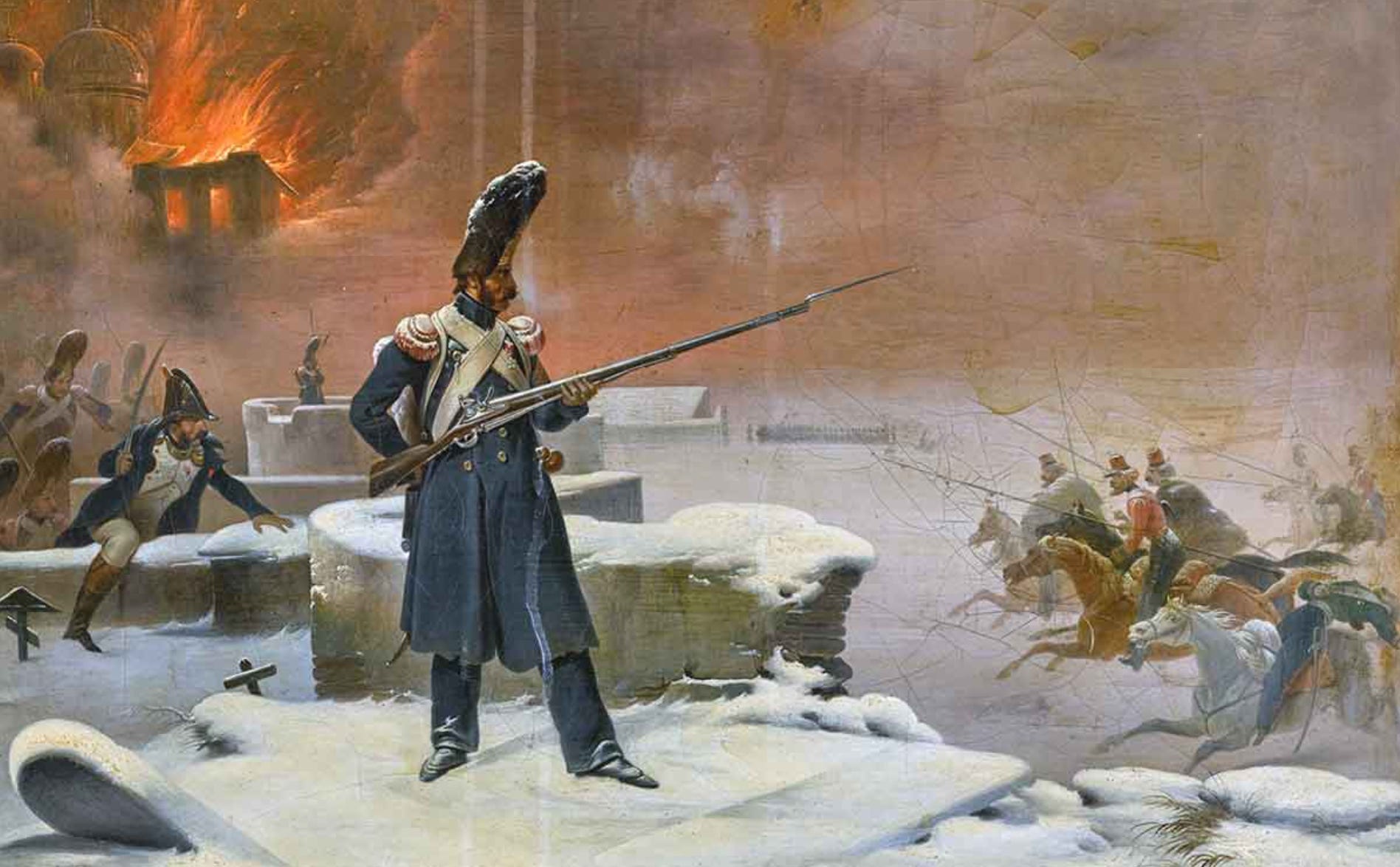
Scene from the Russo-Turkish Wars by unknown artist, 19th century. (CREDIT: Sotheby’s)
Thibert: A little history lesson. Is Türkiye still afraid of Russia? How has their relationship changed?
Dr. Kösebalaban: Russia is certainly a continuing rival for Türkiye. It will become a rival in the future as well. The political interests of these two countries are synchronous. In certain cases, they may come together and Türkiye may buy natural gas from Russia. Russia may buy tomatoes from Türkiye.
When it comes to strategic interests of Ankara, there is no chance of them pivoting to Russia. The Russian s-400 Missile System was an exception deal after the failure of the United States to sell Patriot Missile systems to Türkiye.
By all accounts, despite all this turmoil in Turkish–American or Turkish–European relations, Türkiye, by its own interpretation, is a member of the Western security establishment.
So Türkiye is different in that sense from Iran. Iran may form strategic alliance relations with Russia. Türkiye cannot. You need to understand this from the perspective of Russia. They have a very significant ethnic Turkish population. Russian ethnic stock is aging. Most of the Muslim ethnic stock are Turks. Muslims have always been culturally close to Turks such as Chechens. We have many Chechens population living in Türkiye and Circassians.
Mostly the Chechens are very significant in key positions in Russian military. Most of the soldiers are from them. Russian security establishment also doesn’t look at this naively. They look at this as a threat so these two countries, despite occasional areas of cooperation, are locked into an eternal security competition. This is not different from the time of the Ottoman Empire.
In the last 100 years of the Ottoman Empire, the Empire lost about 14 wars with Russia. We had 16 wars and won 2. That left a very strong memory in the minds of the security establishment. I think that continues.
Despite all this negativity, rhetoric, in the discourse with the relations with the Western powers, Türkiye is not seeing Russia as an alternative, that is impossible. But at the same time, you need to add this. Ankara buys 60% of their natural gas from Russia. It has to balance the relation between Russia and Ukraine. At the end of the day, they chose Ukraine.
Thibert: Why Ukraine?
Dr. Kösebalaban: Ankara doesn’t want them to win this war and become hegemonic in the northern part of the Black Sea. Two reasons. One is Russia is to dominate in that part of the world. The second the Turkish population in Ukraine and Ukrainians in general are closer to Turks strategically speaking. Ankara has to play this game very, very delicately. Because there are also problems with the United States and Europe. There is also the dependency on Russia for natural gas. Ankara has to play diplomacy. Of course, both sides know this. Strategic interests are strategic interests.
Thibert: I want to get your thoughts on Turkish foreign relations in various regions of the world. Let’s start with the African continent. Has the relationship with Kenya evolved since they assisted with the capture of Abdullah Ocalan? Is there involvement in the region have to do with their Ottoman past?
Dr. Kösebalaban: I’m not an expert in Africa. Türkiye played a very diplomatic roll in economic relations with many African nations. This was Davutoglu’s contribution from when he was foreign minister. Africa is a rising area, especially in Somalia. Ankara has a strong strategic alliance with Somalia. In other countries, humanitarian organizational are bringing investments. In some countries, they are opening water irrigation systems. Türkiye is one of the players in African domain. China is the biggest player. Certainly, Russia also a huge player. The United States is getting weaker and weaker. Türkiye’s NGOs and government activities are doing tremendous work throughout Sub-Saharian Africa and the East and West.
Turkish soft power, which is being replaced by hard power, the image of Türkiye’s foreign policy is very significant. Turkish Airlines is one of the players. Many people living in the United States came from Africa, especially Somalian population. Right now, if one of them wants to go to Somalia, they only have one airline, that is Turkish Airlines.
One plane from Istanbul and from there to Mogadishu. No other airline can do that. Turkish Airlines is connected to almost all Africa cities this way. Turkish Airlines is a soft power. Turkish television is also another one. NGOs and governmental organizations such as Turkish Cooperation and Coordination Agency (TIKA) repair infrastructure and historically important sites so tremendous money is being spent.
Ankara gave, I believe, $30 million to Somalia as foreign aid. Many people inside Türkiye criticize this; they say, “We are suffering an economic crisis here and you’re still giving this money.” I think this foreign aid is another part of policy. One of the most successful elements of Turkish foreign policy is its relations with Africa.
Another thing about this soft power is bringing students from African countries to Türkiye. A university was closed down by the Erdoğan government. I mention this in the introduction in the book. Actually, in the preface. In that university, African students were being flaunted as the best students at that department. Students came from Kenyan and other countries. The Kenyans were very successful. Those kids would not be given an opportunity if they don’t come to Türkiye . When they were done, they were sent to the United States for their PhD.
Türkiye gives a lot of scholarships to African students. This is one of the most successful sides of foreign policy.
Turkey, Thailand discuss free trade agreement, Sep 5, 2019 (CREDIT Money Talks)
Thibert: I want to quote an article published in March 2026 by Frontiers in Political Science titled: “Turkey as a middle power in Central Asia: Regional cooperation amid geopolitical competition with Russia, China, and the United States.”
“Findings indicate that Turkey’s influence in Central Asia is conditional and layered: it grows where identity and connectivity are translated into institutional routines and business networks, but remains constrained by Russia’s entrenched security role, China’s geo-economic scale, and uneven regional receptivity.”
What type of results do you predict Ankara gaining over time? What issues do you believe this “low involvement” strategy will offer them?
Dr. Kösebalaban: This contributes to my previous answer on Russia. One of the areas of competition between the two countries is Central Asia. They were part of the same empire, Soviet Union. They had institutions and within those institutions certainly Central Asian countries wanted to diversity and move away from that past. At the same time, they also don’t want to create a discontinuity and rupture in the government.
Türkiye steps in. Originally during the time of Özal when the Cold War ended, he did that with the support of the United States. The same statements I made about Africa apply here in terms of the humanitarian side of diplomacy from foreign policy and cultural ties. We have stronger cultural ties with Central Asia countries from the fact there is a common ethnic background. One it is exaggerated. It also receives a reaction from the local people there because they have their own distinct identities. Uzbek identity is a very strong identity. Although we speak the same language, it is barely mutually intelligible.
It has similar grammar and 60% of the words are similar. So, when the Cold War ended, Özal exaggerated these similarities and Türkiye projected itself as an elder brother. This was reacted to by many countries, particularly Uzbekistan and Azerbaijan. Türkiye also meddled in domestic affairs. Trying to support people not from the Soviet training background. This received a strong reaction from many in these countries. Right now, the relationship continues on a more equal footing. I think Ankara doesn’t project itself as an elder brother or a stronger country to them.
There is also the organization of Turkish states that meet periodically under the rubric of this organization. You may be surprised by this, but Hungary is an observing member. Because Hungary is coming from the Hun Empire, this not supported by Russia and China. But can Türkiye balance against them? No. China, at the end of the day, will dominate the economies of those countries. It is very risky. Most of these countries have huge lands but are underpopulated. China has an enormous population. Türkiye is a balancing factor it can play important roles in bringing them closer to Turkish way. Turkish television series are very popular.
The other day, I met someone from Ethiopia whose mother loves Turkish programs. Central Asian countries also watch them, because we speak the same language, but in different forms. Their language is changing to the side of Türkiye Turkish. Imagine an American kid watching BBC and having an English accent.
Thibert: This brings me to SW Asia….In 2019, the Asia Anew Initiative was launched by the Ministry of Foreign Affairs of Türkiye. It has been a few years since its launch, so what type of developments have been made after its launch? What expectations does Ankara have for this relationship?
Dr. Kösebalaban: Malaysia and Indonesia. We have a very strong relationship. That also goes back to Necmettin Erbakan as prime minister (1997–1998). He formed an organization called D-8. In this D-8, Malaysia, Indonesia, and other Muslim countries are members. It doesn’t mean any substantial thing, but it gives them a platform to meet occasionally. These contacts are important because each time they visit each other the visits are followed by a sea of businessmen, politicians, and all sorts of people. Between Indonesia and Türkiye, the relationship is strong.
Malaysia is closer to Türkiye. Prime Minister Anwar Ibrahim has a similar background to Erdoğan. One thing you should not forget is that 60%–65% of Türkiye industrial exports are to Europe. Not to Asia so in that sense, they are too far from Türkiye. Exports of drones to them and military equipment like light military vehicles on this level relations continue. Türkiye is not powerful enough to play a global power card. They cannot balance with China.
China is two dimensions: Big China and the other domestic Chinese population. The economic Chinese are economically dominate. In that end, SW Asia wants the United States to play a bigger role, but Türkiye is weaker.
Thibert: A prediction for the future. Can the Justice and Development Party (AKP) survive without Erdogan if they are able to find a successor?
Dr. Kösebalaban: May survive. But Erdoğan’s charisma cannot be replicated by a successor. All of the things that I said about the failures in policy do not affected him. Makes it impossible. For example, if his son follows him, there is a chance the party may survive, but more chances the opposition will gain power.
If JDP wants to survive in power, it has to be more authoritarian. Türkiye cannot economically survive a more authoritarian government. Economic dynamics in Türkiye are forcing a more open system. China is a not a model for Türkiye. I am saying this because some people are arguing that we copy this model because China is successful.
That we don’t have to be democratic. Democracy is not only about working but also about a separation of powers. Justice. Courts are important and need to be independent. All of these things are tied to economic stability, and right now the stability must be returned in both economic and judicial senses.
I think it can survive, but it will be very hard. It will require a lot of hard power against opposition. This continuation may not be very successful.
Türkiye is a middle-to-major-status country. It will continue to be so. It has more soft power in the sense that it comes from an Islamic Caliphate background. This gives it a status that Türkiye capitalizes on. It also has the Imperial background because of the Ottoman Empire.
Thibert: Has their empirical background ever bitten them? The United States or other Imperial powers current or in the past have “helped” other countries. The history is sometimes invoked. In the case of Türkiye, has this happened?
Dr. Kösebalaban: Sometimes, yes. An imperial background plays both a positive role, for example, dealing with Muslims. It also a negative role because this empire. Every empire is about domination. The Ottoman Empire didn’t leave necessary a positive view to many people in the region.
So, it is both. Don’t forget that it also gives it a very positive image and role in the Middle East, Central, and SE Asia.
Türkiye is certainly, and I say this to conclude this, a bigger power than its real power. Its potential is higher than its actual power. This mismatch is between potential and actual powers or the central potential powers. Türkiye can actually do bigger things, but actual power is limited and creates an imbalance between reality and idols. This imbalance makes it difficult to rationalize a foreign policy.
Thibert: Thank you for your time.
Erdogan raises questions about U.S. partnership over weapons deal, Sep 18, 2017 (CREDIT PBS News Hour)
Recommended Reading:
